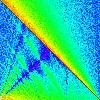
The evolution property of Cellular Automata Rule 23-3 known as Conway's Life have been known to be chaotic. This means a small change in initial condition, will have a big effect on the evolution of said world.
This Morning (August 10th 2008,1 AM (GMT+8)) I had been lucky enough to observe this particular property of Rule 23-3 while doing some experiments involving 21 Conway's Worlds.
The experiments involved 7 worlds with worldsize of 30 x 30 pixels, 7 worlds with worldsize of 60 x 60 pixels and 7 worlds with worldsize of 120 x 120 pixels. The main objective of the experiments was to determine the average longevity of Conway's world in relation to the worldsize of said Conway's world.
What interest me the most was an unusually high longevity observed in one world with worldsize of 120 x 120 pixels. This particular initial condition below, was shown to have longevity of 9150 cycles.
This Morning (August 10th 2008,1 AM (GMT+8)) I had been lucky enough to observe this particular property of Rule 23-3 while doing some experiments involving 21 Conway's Worlds.
The experiments involved 7 worlds with worldsize of 30 x 30 pixels, 7 worlds with worldsize of 60 x 60 pixels and 7 worlds with worldsize of 120 x 120 pixels. The main objective of the experiments was to determine the average longevity of Conway's world in relation to the worldsize of said Conway's world.
What interest me the most was an unusually high longevity observed in one world with worldsize of 120 x 120 pixels. This particular initial condition below, was shown to have longevity of 9150 cycles.
Initial Condition | Death Condition |
|---|---|
 |  |
This unusually high longevity (about 2.135 Standard Deviation from the mean value) had made me wonder about the rarity or abundance of Conway's world with such long lifetime. So I alter the initial condition by killing one live cell from the original initial condition above. This had decreased the lifetime of the world down to 3059 cycles.
Initial Condition | Death Condition |
|---|---|
 |  |
Since killing one live cell in the initial condition made the longevity of the world being near to the mean longevity value, this might means that initial conditions that produce world with high longevity value to be rare. But more experiments must be done before taking any further conclusions.
If you are interested to help calculating the average lifetime of a Conway's world with certain worldsize, just download the program and do some experiments by yourself. Submit your experiment results to this particular maling list Yahoo!Groups : Cellular Automata Research.
If you are interested to help calculating the average lifetime of a Conway's world with certain worldsize, just download the program and do some experiments by yourself. Submit your experiment results to this particular maling list Yahoo!Groups : Cellular Automata Research.